Chinese language
What are the four Mandarin Chinese tones?
Mandarin has four main tones - high-flat (mā), rising (má), low/dipping (mǎ) and falling (mà) - plus a light neutral tone. The tone is part of the word: the same syllable with a different tone is a different word. Learn more →
What are tone pairs and why should I drill them?
Tone pairs are the 20 two-tone combinations that cover almost every two-syllable Mandarin word. Drilling pairs trains the transitions between tones - the part that falls apart in real sentences. Learn more →
Why is the Chinese third tone so hard?
Because the textbook 'dipping' contour almost never appears in real speech - tone 3 is usually just a low tone, and before another third tone it turns into a second tone (你好 = ní hǎo). Learning it as 'low' fixes most of the struggle. Learn more →
What is tone sandhi (tone change rules)?
Tone sandhi are the rules that change tones when words meet: 3-3 becomes 2-3, tone 3 loses its rise before other tones, and 不 and 一 shift tones depending on what follows. Pinyin doesn't write these changes - you have to drill them. Learn more →
Chinese learning
How can I practice Chinese tones by myself?
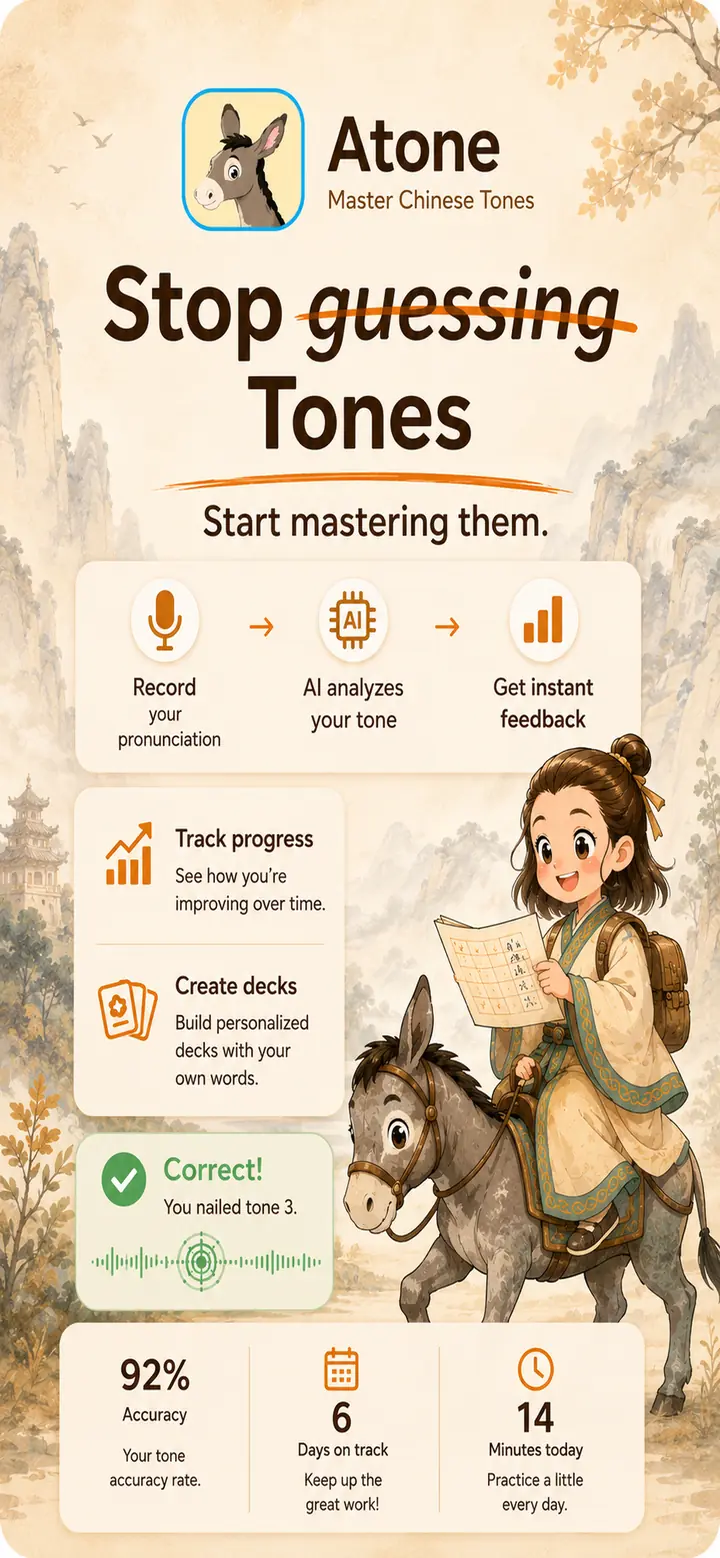
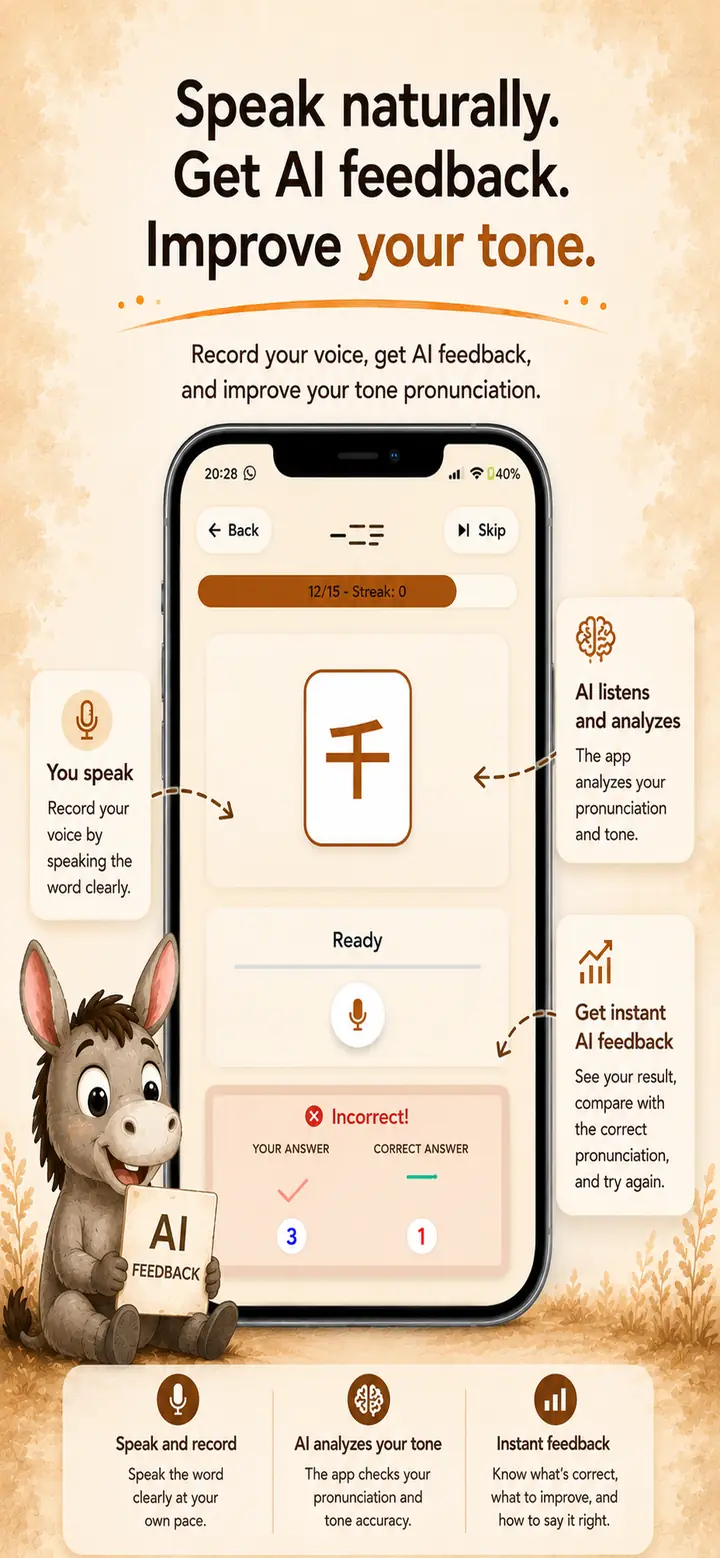
Pair recognition practice (see a word, name its tone) with speaking practice that tells you what you actually produced. Atone covers both: a Recall session has you name the tone, and a Speak session records your voice and uses AI to identify the tone you produced. Learn more →
Why can't I hear the difference between Chinese tones?
Your brain learned to treat pitch as emotion, not meaning - so it filters tones out. Forced-choice drills with instant feedback retrain that filter, usually within weeks of short daily practice. Learn more →
Can an app really check my Chinese pronunciation?
Yes. Tones are pitch shapes, and speech AI can extract the pitch contour from your recording and classify which tone you actually produced. Atone tells you your tone vs. the correct tone on every attempt. Learn more →
Why don't native speakers understand my Chinese?
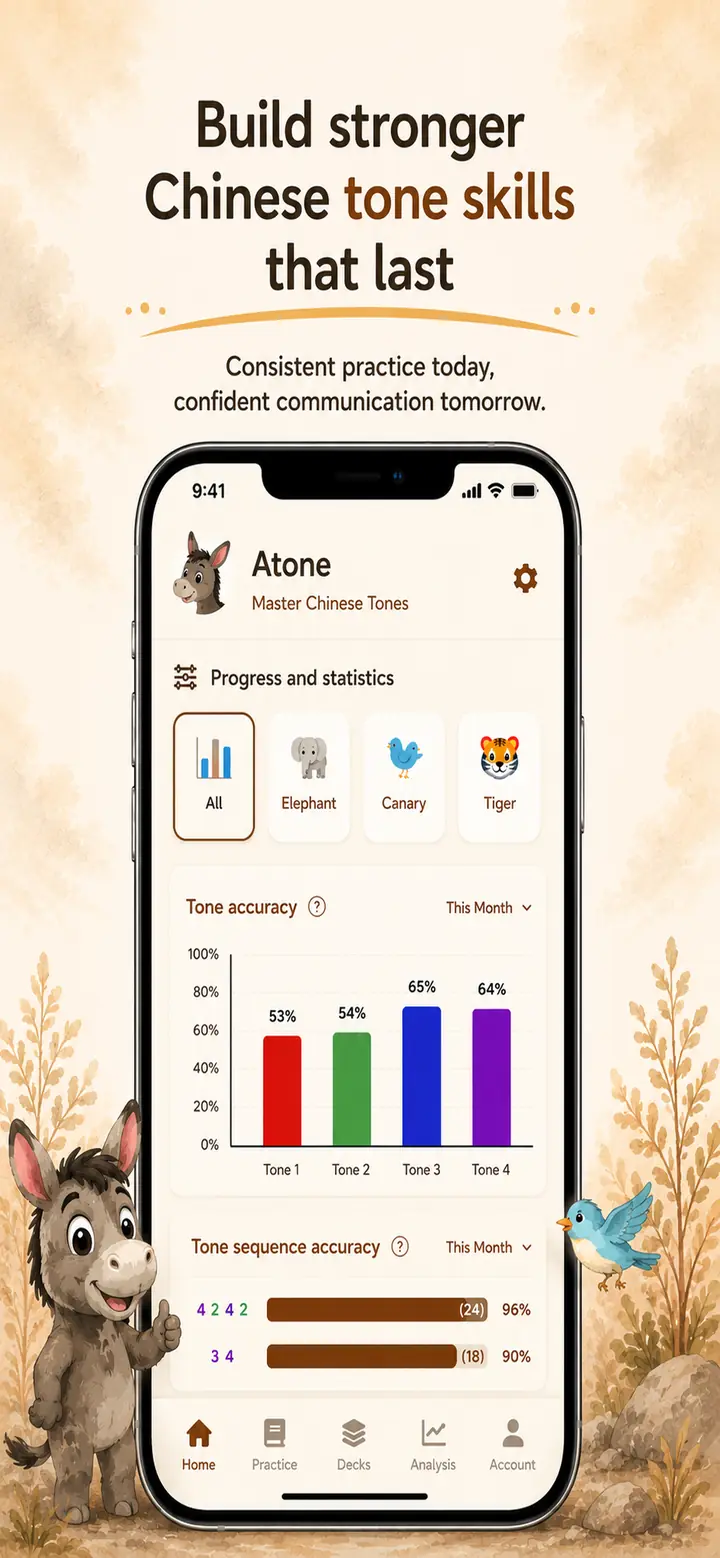
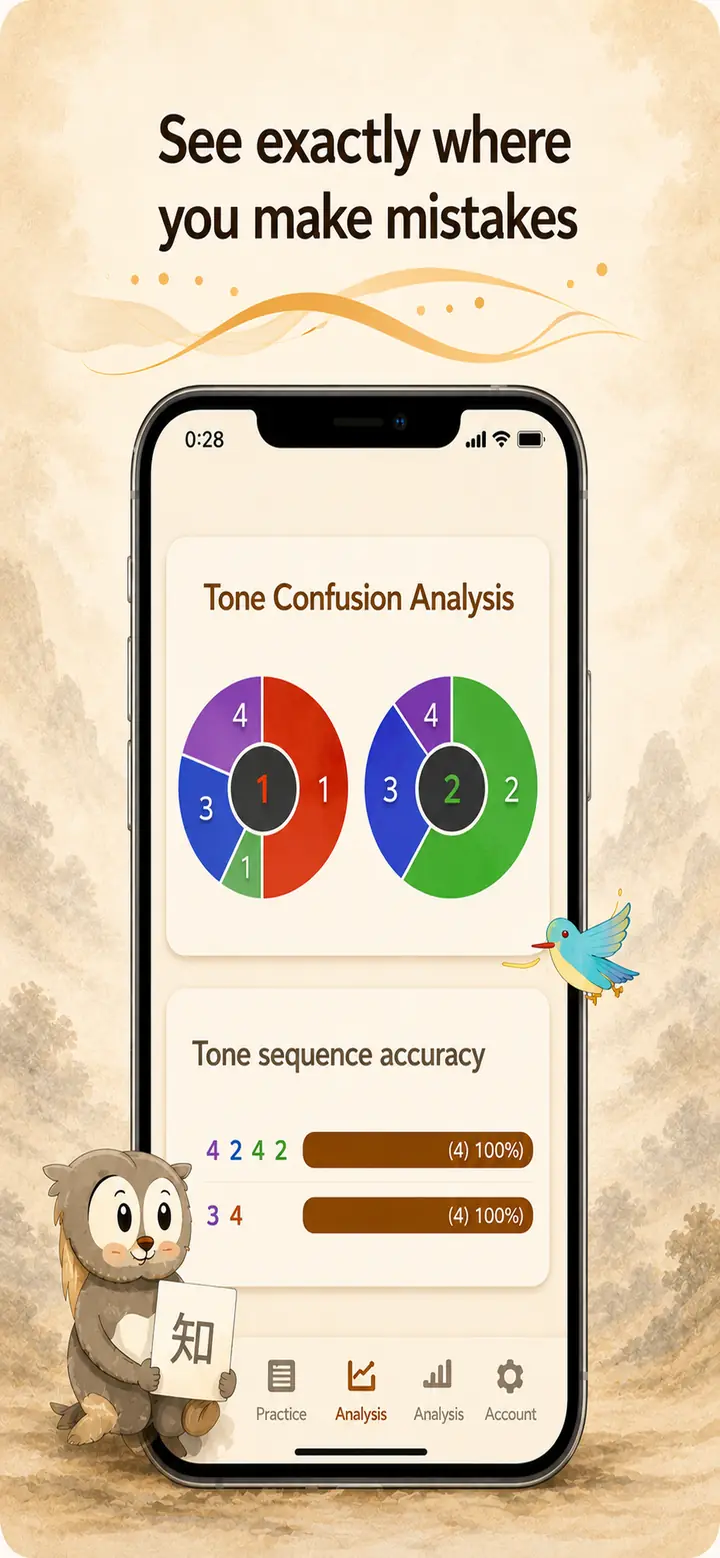
For intermediate learners it's almost always fossilized tone errors - systematic habits you can no longer hear yourself. Atone's Tone Confusion Analysis maps exactly which tones you swap so you can fix them one at a time. Learn more →
What makes a good practice deck?
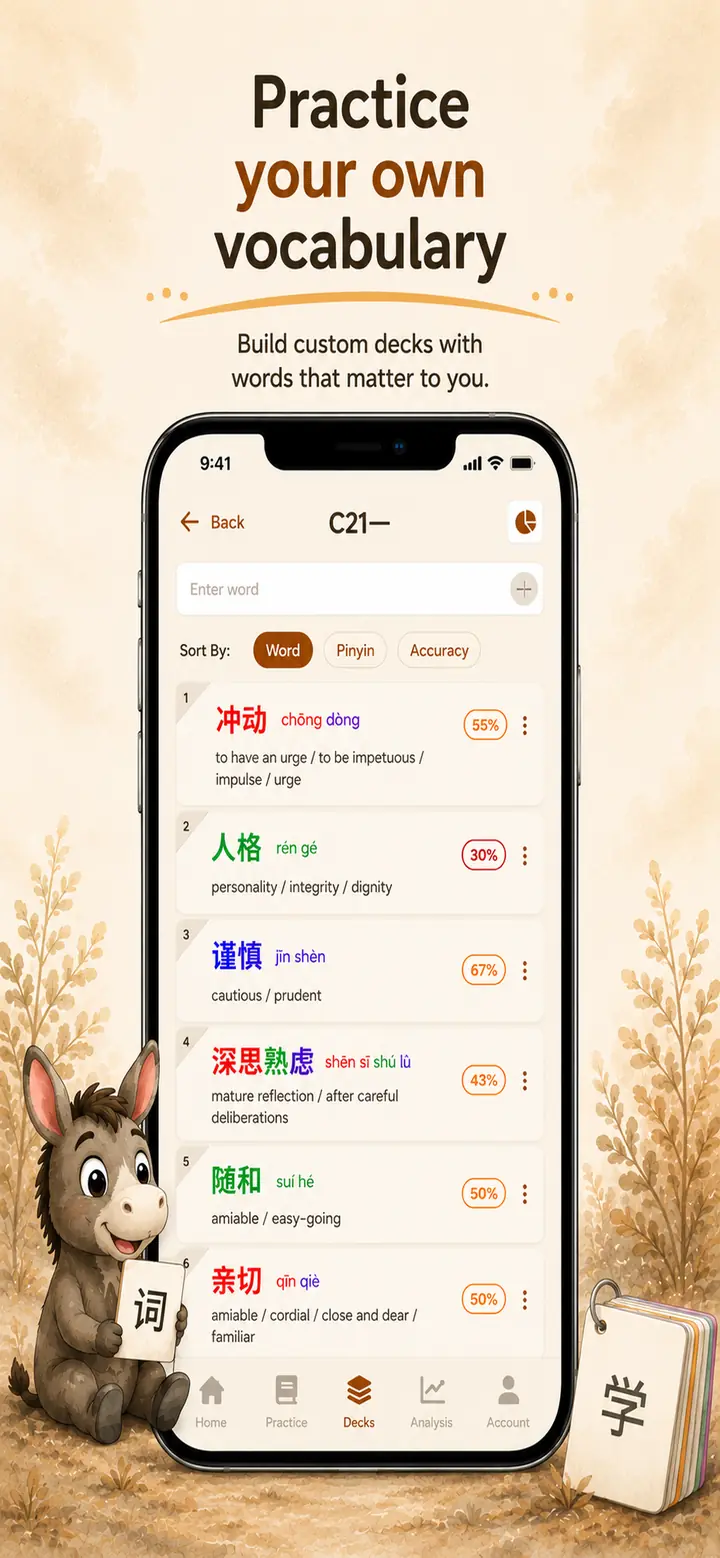
Small enough to finish (15-30 words), built from one source (a chapter, a conversation), with tone-confusable pairs included - and built by you: creating the deck yourself measurably boosts memory (the generation effect). Atone's dictionary makes it take minutes, and Smart mode handles the review schedule. Learn more →
Atone app
Can I practice tones with my own vocabulary or HSK lists?
In Atone, yes - type any word and the built-in dictionary (100,000+ entries) fills in characters, pinyin and meaning, so you can build custom decks around your course or HSK level. Atone Pro also imports vocabulary lists straight from Pleco, Quizlet and other apps, so a list you already keep becomes a tone deck without retyping. Every word tracks its own accuracy so you always know what to drill next. Learn more →
Can I import my vocabulary from Pleco, Quizlet or another app?
Yes, with Atone Pro. Import a vocabulary list from Pleco, Quizlet and other apps, and Atone turns it into a practice deck - so the words you have already collected become tone practice without retyping them. Learn more →
How does practice work in Atone?
Two independent choices. The session type sets what each rep asks of you: Recall shows a character and you pick its tone, Speak shows the pinyin and you record it, and Recall & Speak shows a character and you record it, so reading and pronunciation train together. The practice mode sets which cards come up: Smart schedules your weakest words for you, while Shuffle and Ordered let you run a deck the way you want. Learn more →
Does Atone use spaced repetition?
Yes - it's the default. Smart decides which cards come up next, automatically scheduling reviews of the words you're weakest on, Anki-style, without you managing a queue. Shuffle and Ordered are there for when you'd rather run through a deck yourself. Learn more →
Does Atone cover HSK vocabulary?
Yes - decks for every HSK level 1 through 9 are included free. Practice them in any mode, or use them as a starting point and build custom decks around your own course. Learn more →
Is Atone free? What platforms does it run on?
Atone is a free download on iOS and Android with no ads: every practice mode and ready-to-practice decks for all HSK levels 1-9 are free. Atone Pro (monthly or yearly, cancel anytime) unlocks unlimited AI speech analysis, vocabulary-list import from Pleco, Quizlet and more, the full ready-to-practice deck library and the full analytics suite. Download Atone →