Chinese tones guide
The Third Tone Is Not What Your Textbook Said
Tone 3 is the tone learners fight longest, and the standard explanation is a large part of why. You were probably taught a dramatic dip-and-rise, the "✓ shape". In real, connected speech that full contour almost never happens — and once you know what replaces it, most of the struggle dissolves.
What tone 3 actually is: a low tone
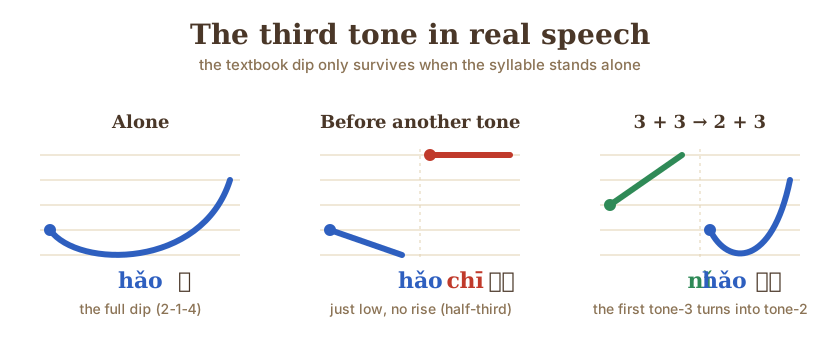
Here is the single most useful correction a tone-3 learner can receive: in connected speech, think of tone 3 not as a dip-and-rise but simply as the low tone. Native speakers drop to the very bottom of their range — often with a slightly creaky, pressed quality, sometimes called vocal fry — and hold it there. The rising tail that your textbook drew so prominently only shows up in one narrow situation: when the syllable stands completely alone, or falls at the very end of a phrase where the voice has room to bounce back up.
Why does this matter so much in practice? Because if you produce the full textbook dip on every third tone, two bad things happen. You sound slow and stilted, dragging each tone-3 syllable through an elaborate contour real speakers do not use; and, more practically, you run out of breath and time in the middle of ordinary words, because that V-shape takes far longer to execute than a low, flat syllable does. The dip-and-rise is not wrong, exactly — it is a citation form, the way a word is pronounced in isolation for a dictionary — but it is the wrong default for talking. Adopt "low" as your default and you immediately sound more natural, and you free up the time and air that the dip was eating.
The two rules that cover almost every case
Nearly all of tone 3's apparent complexity comes down to two rules. Learn these and you have the behaviour of tone 3 in the overwhelming majority of real words.
1. The half-third rule
When tone 3 is followed by a tone 1, 2, 4, or a neutral tone, you pronounce only the first half of the textbook shape: go low and stay low, with no rise at all. This "half third" is the most common form of tone 3 in the whole language, precisely because tone 3 is followed by some other tone far more often than it stands alone. In hěngāo 很高 (very tall), the hěn is just a low syllable that then hands off to a high, level gāo — no dip, no bounce. Hear it as "low, then high," and you have it.
2. The 3-3 rule (tone sandhi)
When two third tones meet, the first one changes into a second tone. So nǐhǎo 你好 is written with two tone-3 marks but spoken as níhǎo, with a rising first syllable. This trips people up because the pinyin keeps its original tone-3 marks — the change lives only in the mouth, never on the page — so there is no written cue reminding you to apply it. That is exactly why it has to be drilled until it is reflexive rather than merely known. It is one of a small family of tone change rules worth learning together.
Why learners confuse tones 2 and 3
Almost every learner spends a long stretch unable to reliably tell tone 2 from tone 3, and the reason is now visible from the two facts above. Both tones involve rising: tone 2 rises by definition, and the "full" tone 3 ends with a rise, while the 3-3 rule literally turns a tone 3 into a tone 2. If your ear is listening for "which one goes up," the two are genuinely tangled, because the honest answer is sometimes "both."
The way out is to change the question you ask the sound. Do not listen for the rise; listen for the floor. Tone 2 begins in the middle of the range and moves up from there. Tone 3, in natural speech, drops to the bottom first — that low, slightly creaky anchor is its signature, present even when the rise is not. Re-anchor on height rather than shape — tone 2 is "mid, going up," tone 3 is "low" — and a distinction that felt hopeless usually resolves within a couple of weeks of focused drilling. If the pair is your particular sticking point, the guide on hearing the tones goes deeper into the listening drills that separate them.
How to actually fix your tone 3
Knowing all this does not yet change your mouth; drilling does. The most efficient practice targets tone 3 specifically rather than hoping it improves inside general review. Build a small set of common tone-3 words and 3-3 pairs — 你好, 很好, 老板, 可以, 所以, 我也 — and work the two habits deliberately: train your ear first to accept a plain low syllable as a tone 3 even when it barely rises, then practise saying those words and 3-3 pairs and check that your low-and-lazy half-third still reads as a real tone 3, and that your 3-3 words genuinely come out 2-3. This is the sort of narrow, targeted drilling that recorded-and-checked practice — an Atone Speak session, for instance — makes easy to verify, since the whole question is whether your production matches the shape, and that is exactly what an AI tone checker is good at. Tone 3 is usually where learners start lowest; it is also, once the picture is corrected, where they tend to improve the fastest.