Chinese tones guide
Mandarin Tone Pairs: The Highest-Leverage Tone Drill
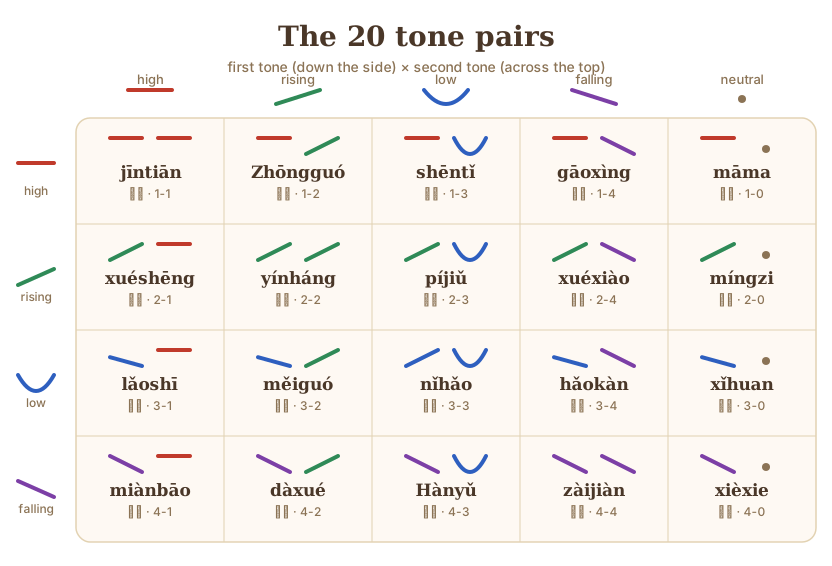
You can pronounce all four tones perfectly in isolation and still fall apart mid-sentence, because tones interact where they meet. Since most Mandarin words are two syllables, the two-tone combination — the tone pair — is the natural unit to practise, and drilling it is the best return on effort in the whole tone system.
What a tone pair is
A tone pair is just the tone pattern of a two-syllable word, named by its two tone numbers. Zhōngguó 中国 (China) is a 1-2; nǐhǎo 你好 is a 3-3 (spoken 2-3, once the sandhi rule applies); dànshì 但是 (but) is a 4-4. Count the combinations — four tones each followed by four tones, plus the neutral tone in second position — and you land on about 20 core patterns. That number is the whole point: every two-character word in the language falls into one of roughly twenty buckets. Master the twenty and you have the pronunciation skeleton of most of the vocabulary you will ever learn.
Why pairs beat single-syllable drills
Beginners often drill tones one syllable at a time — mā, má, mǎ, mà — and then wonder why their speech still crumbles in real sentences. The answer is that single-syllable practice trains the wrong thing.
- The transition is the hard part. Producing a clean tone 4 and a clean tone 2 in isolation is one skill; flowing from a falling tone straight into a rising one, without a hitch or a reset, is a different one — a motor skill your mouth only builds by practising the join. Single syllables never make you cross that seam, so they never train it.
- Pairs teach real rhythm. Mandarin speech naturally chunks into two-syllable units, and the pair carries that cadence. Drilling pairs is the closest thing to practising the rhythm of actual sentences without leaving the safety of a short, checkable unit.
- The coverage is extraordinary. Twenty patterns is a small, finite syllabus, and clearing it unlocks the tonal shape of tens of thousands of words. Few things in language learning have this ratio of effort to payoff.
The patterns worth extra attention
Not all twenty pairs are equally hard, and it is worth knowing where the difficulty clusters so you can spend your time well. Anything involving tone 3 tends to be the sticking point, for two reasons that compound: tone 3 is the tone people misproduce most on its own, and it is also the one that changes in combination — 3-3 becomes 2-3, and 3-before-anything-else becomes the low half-third. So pairs like 3-3, 3-2, and 3-4 ask you to get a tricky tone right and apply a change and nail the transition, all at once.
The other reliable troublemaker is any pair that stacks two of the same strong movement — 4-4, where two sharp falls follow each other (dànshì 但是), and 2-2, where two rises run together. These are not conceptually hard, but they are physically tiring to keep crisp, and learners tend to flatten the second syllable. If you only have time to audit a few pairs, audit the tone-3 pairs and the doubled-movement pairs first.
A simple tone-pair practice plan
- Take one pair per session. Pick a pattern — say 2-4, méicuò 没错 (that's right) — and make it the whole focus for that sitting. Trying to drill all twenty at once guarantees none of them improves.
- Drill five to ten common words in that pattern until the transition feels physical rather than calculated — until you are no longer thinking "rise, then fall" but simply saying the word.
- Then mix pairs and check they hold apart. It is easy to sound perfect on a pair in a block of identical pairs and lose it the moment the surrounding pattern changes. Interleaving is where real robustness is built.
- Keep a note of which pairs stay weak and return to them. In practice the weak list is dominated by the tone-3 pairs, so do not be surprised if that is where your effort keeps going back.
Getting feedback on your pairs
There are excellent listening resources for tone pairs — Sinosplice's tone-pair drills and the AllSet pronunciation wiki are the classics, and they are worth using to build your ear for how each transition should sound. What they cannot tell you is whether your production of a given pair actually matches, and that is the piece most learners are missing: you can listen to a perfect 3-4 all day and still be producing a 2-4 without knowing it.
Closing that gap needs something that checks what you say, syllable by syllable. This is where recorded practice with AI tone analysis is genuinely useful — in Atone, for instance, a Speak session names the tone you produced on each syllable and the analytics track your accuracy per tone sequence, so weak pairs show up as numbers instead of vague suspicions and you can re-drill exactly the sequences that lag. Whatever tool you use, the principle is the same: practise pairs, not lone syllables, and find a way to verify the transition rather than trusting that it came out right.