Chinese tones guide
Can AI Check Your Chinese Pronunciation? Yes — Here's How
A generation of learners practiced tones into the void: repeat after the CD, hope for the best, and get corrected — occasionally — in class the following week. Speech AI closed that gap. Here is what an AI pronunciation checker actually does with your voice, where it is genuinely useful, and where it is not.
What "checking pronunciation" really means for tones
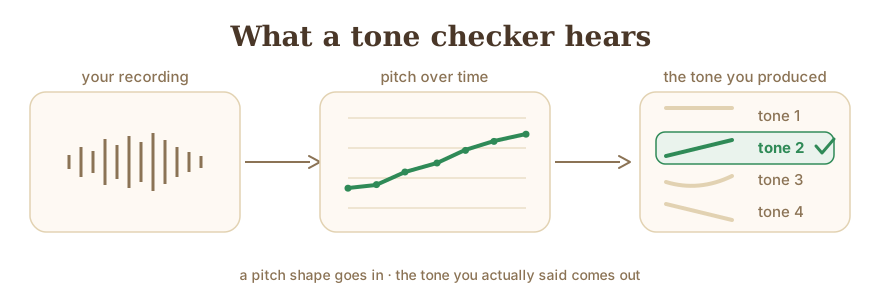
Pronunciation is a broad word, and AI is not equally good at all of it. Vowels, consonants, rhythm and intonation are each their own problem. Tones, though, are unusually well suited to machine analysis, because a Mandarin tone is a physical thing with a clear definition: the shape your pitch traces across a syllable. Tone 1 stays high and level, tone 2 climbs, tone 3 sinks low, tone 4 drops from high to bottom. Those are curves, and curves are exactly what signal processing was built to measure.
So when we talk about an AI tone checker, we are talking about something narrower and more reliable than "grade my accent." The question it answers is precise: across this syllable, did your pitch trace the shape of the tone you were aiming for? That is a question a model can answer well, which is why tone feedback works today even though full accent coaching is still hard.
What the AI actually hears
When you record a word, the model extracts your pitch over time — how it rises, falls, dips or holds steady from the start of the syllable to the end. It then compares the contour you produced against the patterns of native speech and classifies which of the tones it best matches. Two things are worth noting about what it ignores.
First, it does not care about the pitch of your voice. A low male voice and a high child's voice produce completely different frequencies for the same tone 2, because a tone is a relative shape — rising within your own range — not an absolute note. The model normalizes for that, so you are never penalized for the voice you happen to have. Second, it does not care whether you sounded confident, nervous, loud or soft. It reads the contour and nothing else, which is what lets it give the same verdict on a mumbled attempt and a bold one, as long as the shape is the same.
Why instant feedback matters so much
Skill learning runs on feedback loops, and two properties of the loop decide how fast you improve: how quickly the correction arrives, and how specifically it points at the error. Slow, vague feedback barely teaches; fast, specific feedback teaches quickly. A tone checker is valuable precisely because it maximizes both at once.
Consider the arithmetic. If your only correction comes in a weekly class, you might get a handful of tones checked per week, each one long after you produced it, by which point you have forgotten what your mouth did. An AI checker sits at the other extreme: it can check a hundred attempts in ten minutes, each within a second of your saying it, while the movement is still fresh enough to adjust. That is not a small improvement in degree — it is a different regime of practice, and it is the main reason tones that stalled for months can move in a couple of weeks of focused speaking.
What AI feedback is, and isn't, good at
It helps to be clear-eyed about the boundaries, because an overselling here does learners a disservice.
- Genuinely strong at: classifying tones, doing it consistently, and doing it at volume without fatigue or embarrassment. It will check your four-hundredth attempt with the same attention as your first, and it never sighs.
- Not a substitute for: real conversation, natural rhythm across a whole sentence, or the hundred social cues that make speech land. The point of drilling tones with an AI is narrower and honest: to make your tones automatic so that real conversations stop being pronunciation exams and go back to being conversations.
Read that boundary as a division of labor, not a disclaimer. The checker's job is to turn a slow, uncertain part of learning — am I even saying this right? — into something fast and certain, freeing your class time and your speaking partners for the things only humans can give you.
Using a checker well
The tool is only as good as how you point it. A few habits get far more out of one:
- Drill words you will actually say. Feedback on random lesson vocabulary transfers by luck; feedback on this week's words transfers by design.
- When you are marked wrong, read the diagnosis, not just the verdict. Producing tone 2 when you meant tone 3 is a different problem — and a different fix — than producing tone 4. The tone you actually made is the useful information; the red X is not.
- Watch the trend, not the session. One bad session means nothing. Your accuracy on tone 3 over a month, or the shrinking of a specific confusion, is the signal that you are genuinely changing — and it is the number worth checking.
How Atone's AI checker works
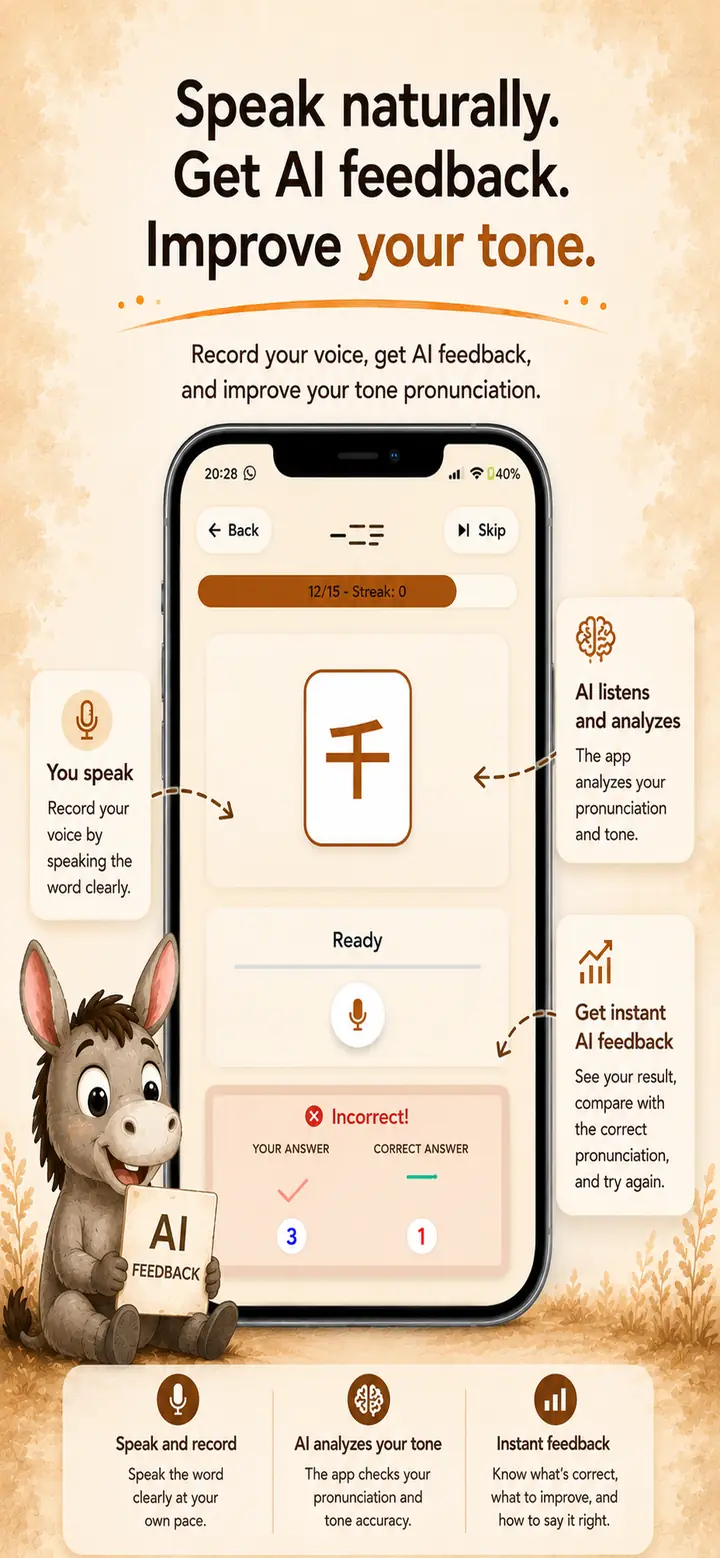
- In Speak practice, Atone shows pinyin and you say the word into the mic.
- The AI analyzes your recording and either marks it correct or shows the tone you produced next to the tone you were aiming for.
- Every result feeds your Tone Confusion Analysis — a running map of which tones you say when you mean another.
- Practice your own decks, so the feedback lands on the vocabulary that matters to you.