Chinese tones guide
How to Learn Chinese Tones, Step by Step
You can memorize the four tone shapes in an afternoon. Producing them at conversation speed, on words you have never rehearsed, is the part that takes real work — and it is a skill you train, not a chart you reread. This is the method that gets you from the table to the tongue.
Why you can't skip them
Mandarin runs on a small set of syllables, so pitch has to carry meaning that consonants and vowels carry in other languages. mā 妈 (mother), má 麻 (hemp), mǎ 马 (horse) and mà 骂 (to scold) share every sound except pitch, and they are four unrelated words. Get the tone wrong and your listener is left rebuilding the sentence from context — which works until it doesn't, and the moments it fails are the ones you care about: ordering food, asking directions, landing a joke.
Almost everyone starts Mandarin with the same quiet bargain: learn the word now, fix the tone later. Later has a way of never arriving, and a year in you have a vocabulary of several hundred words you say with tones you never checked. Going back and getting those tones right — atoning for the shortcut — is where this app got its name. The encouraging part is that tones respond quickly to the right kind of practice. The method below is four steps, in order, because each one depends on the one before it.
Step 1: Train your ear before your mouth
You cannot reliably produce a contrast you cannot hear. If tone 2 and tone 3 still sound like the same "rising-ish" thing to you, drilling your pronunciation just rehearses the confusion — you have no way to tell a good attempt from a bad one. So spend your first sessions on recognition alone: hear a word, commit to a tone, find out whether you were right.
Research on tone acquisition points the same way: perception tends to lead production, and learners who train listening first tend to pick up the sounds faster. The reason is intuitive once you see it — your ear has to build four stable categories before your mouth has anything to aim at. Short daily sessions do this far better than a single long one, because you are teaching your brain to sort sounds, and sorting improves with repetition and sleep, not with marathon cramming.
Step 2: Speak, and get corrected on every attempt
Repeating after a recording feels productive, but with nothing checking you, a wrong pitch shape can harden over months without you noticing. This is the trap that catches diligent learners: they put in the hours, and every hour reinforces the same mistake a little deeper. What breaks the cycle is feedback — something that listens back and names what you produced.
That something can be a teacher, a patient native-speaker friend, or an app that reads your recording and tells you the tone you said. The form matters less than two properties. It has to be specific — which tone did I actually produce? — because "wrong" alone gives you nothing to change. And it has to be fast, because a correction that arrives a week later, in your next class, teaches almost nothing; you have long since forgotten what your mouth was doing. A verdict that arrives in a second lets you adjust and try again while the movement is still warm.
Step 3: Drill tones inside real words
Isolated syllable drills — mā má mǎ mà — are useful for a day or two and then stop transferring. Real speech never hands you one syllable at a time to consider; it arrives in words, mostly two-syllable words, and the hard part is the transition from one tone into the next. A falling tone flowing straight into a rising one is a motor skill that single syllables never train.
So drill the vocabulary you actually use — this week's chapter, the words from last night's conversation — and pay attention to how the tones combine. The 20 two-syllable combinations, or tone pairs, cover almost every two-character word in the language, so working through them by pattern buys you enormous coverage for a small amount of effort. Practicing on words you are about to say has a second payoff: what you drill tonight, you can use correctly tomorrow, and that visible transfer is what keeps people going past week three.
Step 4: Find your own error, then aim at it
Most learners do not make random tone mistakes. They make the same mistake, on the same kind of word, over and over — a signature confusion. For English speakers it is very often tone 2 said where tone 3 was meant, or tone 4 gone flat at the end of a sentence, where English question-and-statement intonation quietly takes the wheel.
The difficulty is that you cannot hear your own signature error: your brain corrects it on playback, so it sounds fine to you and wrong to everyone else. That is exactly why it can survive for years of diligent study. The fix is not to practice everything harder — it is to find the one habit that is actually in your way and drill that alone. A teacher can map it for you slowly; recorded practice with tone-by-tone feedback maps it on its own, as a running tally of what you say when each tone is the answer. Once you can name your pattern, you can usually shift it in days rather than years.
A realistic weekly rhythm
None of this takes long per day; it takes often. Ten focused minutes daily beats an hour on Sunday, because you are rewiring perception and building motor habits, and both consolidate with sleep between sessions. A workable first month looks like this: spend the first week mostly on recognition (Step 1); then shift most sessions to speaking with feedback (Steps 2–3) while keeping a few minutes of listening as a warm-up; and from week two, glance at your error pattern (Step 4) to decide what tomorrow's deck should hold. Do that, and the tones stop being a table you consult and start being part of how each word lives in your memory.
Doing this in Atone
- Start with Recall practice: see a character, pick its tone. This is pure ear-and-memory training, the phase most learners skip.
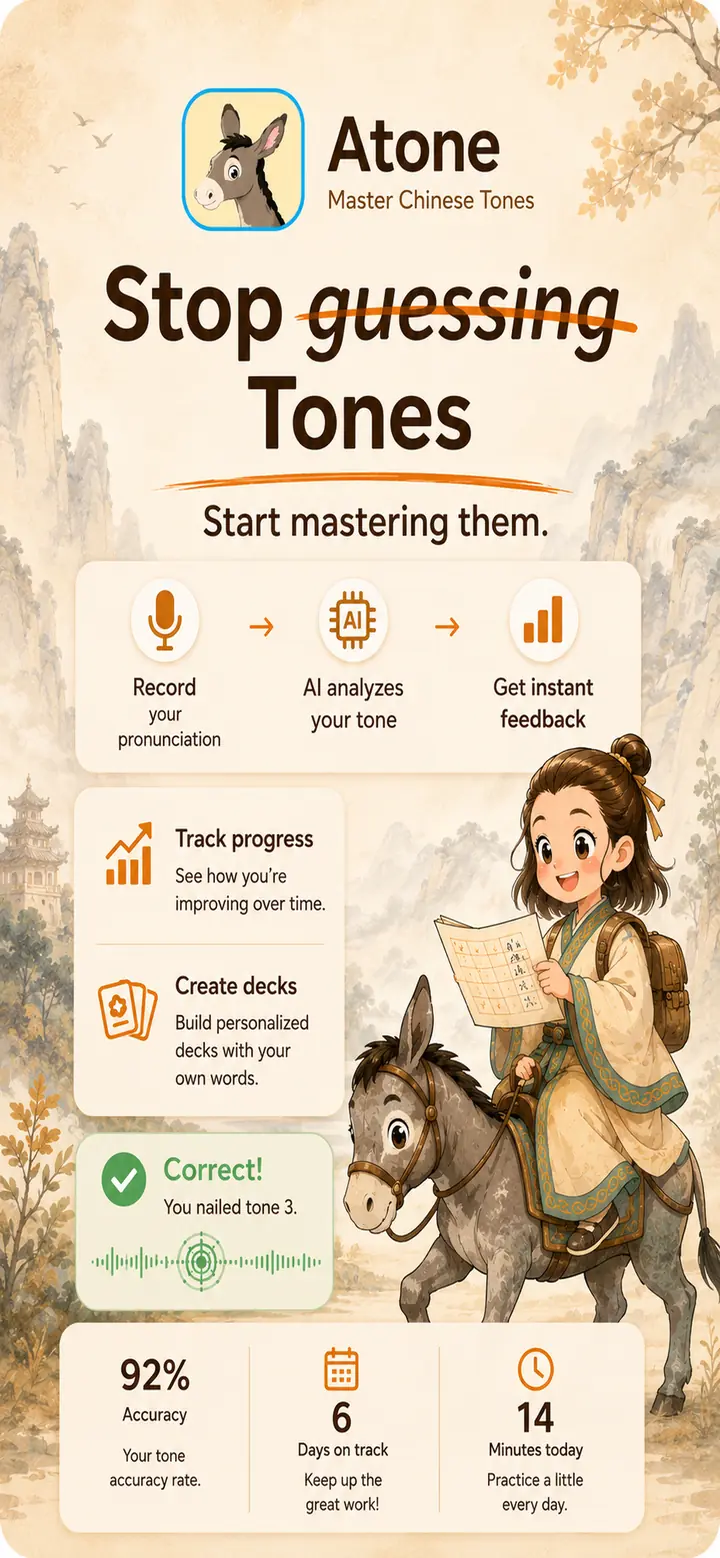
- Move to Speak practice: the app shows pinyin, you say the word, and the AI tells you which tone you actually produced — not just whether you were right.
- Add the words from your own textbook or class to a custom deck, so every drill is vocabulary you will use this week rather than someone else's word list.
- Check the Tone Confusion Analysis after a week — it shows which tones you swap, which turns "practice more" into "practice this."