Chinese tones guide
The Four Chinese Tones, Explained for Beginners
Every Mandarin syllable is sung on one of four pitch shapes, and the shape is part of the word — change it and you have changed what you said. Here is what each tone sounds like, with anchors from English you already produce every day without thinking about it.
What a "tone" actually is
Before the four shapes, one idea that saves a lot of confusion: a tone is not the height of your voice but the movement of it across a single syllable. It is relative, not absolute. A tone 1 spoken by a deep male voice and a tone 1 sung by a child sit at completely different frequencies, yet they are the same tone, because both hold level within that speaker's own range. So do not worry that your voice is too low or too high for Mandarin. You are not matching a fixed note; you are tracing a shape inside whatever range you have.
That is also why English speakers already have every physical skill they need. You raise and drop your pitch constantly — to ask questions, to sound surprised, to trail off. Mandarin simply asks you to do those same pitch movements deliberately, syllable by syllable, and to treat them as part of spelling the word rather than as emotional colour.
The four tones at a glance
| Tone | Shape | Mark | English anchor |
|---|---|---|---|
| Tone 1 | High and flat | ā | The steady pitch of a singer holding "aaah" — or a doctor's "say aaah". |
| Tone 2 | Rising | á | The lift at the end of "What?" — a one-word question. |
| Tone 3 | Low (dips, sometimes rises) | ǎ | The low, thoughtful "well…" — creaky, at the bottom of your range. |
| Tone 4 | Falling | à | A firm "No!" — pitch drops sharply from high to low. |
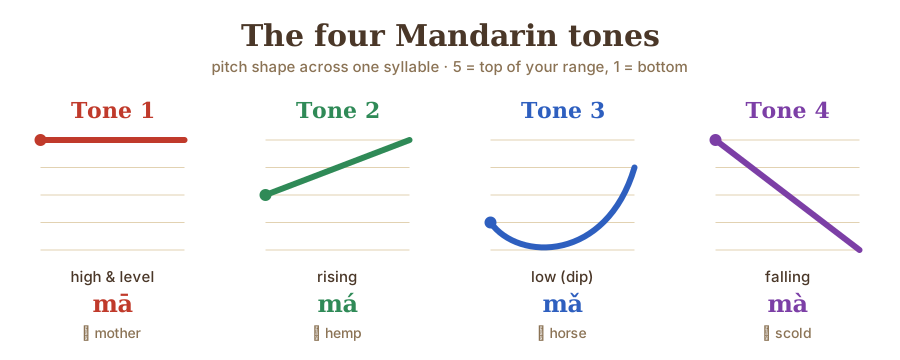
The classic demonstration puts all four on one syllable: mā 妈 mother · má 麻 hemp · mǎ 马 horse · mà 骂 scold. Same consonant, same vowel — four unrelated words, separated by pitch alone. It is worth saying each one aloud now, exaggerating the movement, so the shapes are in your mouth and not just on the page.
Each tone, a little more slowly
Tone 1 — high and flat. The one most people find easiest, because it asks you to not move: pick a comfortably high pitch and hold it, level and steady, for the whole syllable, like the note a singer sustains. The common beginner mistake is letting it sag at the end; keep it flat all the way through.
Tone 2 — rising. Start around the middle of your range and climb, smoothly, to a higher pitch by the end. The English anchor is the incredulous one-word question — "What?", "Me?" — where your pitch shoots up. Do not start high; a rising tone has to have somewhere to rise from, so begin in the middle.
Tone 3 — low. This is the one textbooks describe as a full dip-and-rise, and that description causes more trouble than it prevents. In real, connected speech, tone 3 is mostly just low: you drop to the bottom of your range, often with a slightly creaky, pressed quality, and the little rise at the end usually only appears when the word stands completely alone. For now, learn it as "the low one," not as an elaborate V-shape. There is a whole guide to the third tone once you are ready for the detail, because it is genuinely the trickiest of the four.
Tone 4 — falling. Start high and drop sharply and decisively to the bottom, the pitch of a firm, clipped "No!" or "Stop!". It is short and forceful. The usual beginner error is being too gentle; a good tone 4 sounds almost emphatic.
The fifth wheel: the neutral tone
Some syllables carry no tone of their own. They are short, light, and pitched off whatever came before them — the second ma in māma 妈妈 (mum), or the le in 了 that marks a completed action. There is nothing to memorize here, no shape to trace; you simply say the syllable quickly and lightly and let it lean on its neighbour. Do not lose sleep over it in week one. Just know it exists, so that when a syllable seems to have "no tone," it does not throw you.
Two traps to avoid from day one
- Treating tones as decoration. The single most expensive beginner habit is filing tones under "accent" — something to polish later once the "real" vocabulary is in. Tones are not polish; they are closer to spelling. A word learned without its tone is a word half-learned, and re-learning the tone after a year of saying it wrong is far more work than learning it right the first time. Learn every new word with its tone, from the very first exposure.
- Trusting the textbook tone 3. As above: the dramatic dip-and-rise you will see drawn in most first lessons is real, but rare in ordinary speech. If you drill it as your default tone 3, you build in a habit you will later have to unlearn. Treat tone 3 as low and you will sound more natural sooner.
How to actually start practicing
Reading about the four shapes is the five-minute part; making them automatic is the rest. Two principles get beginners moving fastest. First, train your ear before your mouth — spend your earliest sessions just hearing a word and naming its tone, because you cannot reliably produce a contrast you cannot yet hear. Second, practice inside real words, not endless mā-má-mǎ-mà drills, since tones in the wild come joined together and the join is the hard part. A structured way to do both, with feedback on what you actually produce, is what a good tone practice app is for — Atone is built around exactly this loop — but the principles hold whatever tool you use. The main thing, in week one, is simply to start treating the pitch as part of the word.