Chinese tones guide
Help — I Can't Hear the Difference Between Chinese Tones
If mā, má, mǎ and mà all sound like "ma" to you, you are not tone-deaf and you are not the exception. Your brain has spent decades treating pitch as emotion rather than meaning, and it filters tones out before you consciously notice them. That filter was learned, which means it can be retrained.
Why your ear does this
Nothing is broken. Your auditory system is doing exactly what a lifetime of English trained it to do, and doing it well — the problem is only that the training was for the wrong language.
In English, pitch carries attitude. A rising pitch turns a statement into a question; a falling one signals you are done talking; a sharp jump adds surprise or sarcasm. What pitch never does in English is change which word you said: "cat" is "cat" whether you say it brightly, flatly or in alarm. Faced with that regularity for decades, your brain drew the sensible conclusion — pitch is expressive decoration, not lexical information — and built a filter that normalizes it away so it can get on with identifying consonants and vowels. That filter runs automatically and below awareness, which is why Mandarin tones can feel not just hard but genuinely inaudible: the signal is reaching your ears and being discarded before it reaches your attention.
Mandarin flips the rule that filter was built on. Here pitch is the word, on equal footing with the consonants and vowels. So the task is not to sharpen your hearing — your hearing is fine — but to give your brain enough labeled evidence that it rebuilds the category and stops throwing the pitch away. Studies of tone perception training are encouraging on exactly this point: most learners improve markedly with focused, feedback-driven listening, usually over weeks rather than years.
The training loop that works
The evidence converges on a specific kind of practice — not more listening, but a particular loop:
- Forced choice with feedback. Hear a word, commit to an answer (tone 1, 2, 3 or 4), and then be told the truth. Committing and being corrected is the mechanism; it forces your brain to make a prediction and then hands it the error signal it needs to adjust. Passive listening, however many hours, does almost nothing on its own, because nothing ever tells you whether what you heard was right.
- Start with the easy contrasts. Tone 1 versus tone 4 — high-and-level against a sharp fall — is the friendliest opening, because the two shapes are about as different as tones get. Winning there builds the habit of listening for shape at all. Save the notorious tone 2 versus tone 3 for once the easy pairs feel automatic.
- Keep the reps short and daily. Ten minutes a day rewires categories faster than a two-hour weekend binge. Perceptual learning consolidates during rest, so frequency beats duration; the student who practices every morning outpaces the one who saves it all for Sunday.
- Then close the loop by speaking. Once you can hear a contrast, producing it sharpens your hearing of it further — perception and production reinforce each other, so a little speaking practice feeds straight back into the ear you are training.
A note on tone 2 versus tone 3
This is the pair that stalls almost everyone, and it stalls them for a findable reason: both tones spend time rising, so if you are listening for "which one goes up," they are genuinely indistinguishable. You are asking the wrong question of the sound.
The fix is to re-anchor what you listen for. The reliable difference is not whether the tone rises but where it begins and what happens first. Tone 2 starts around the middle of your range and climbs from there without delay. Tone 3, in natural connected speech, drops to the very bottom of your range first — often with a slightly creaky, pressed quality — and the little rise at the end frequently never arrives at all. So stop listening for "dip-then-rise" and listen for low: if the syllable sinks to the floor of the speaker's voice, it is tone 3, rise or no rise. Once you retune the question this way, a pair that felt hopeless usually separates within a couple of weeks of drilling. There is more on why the textbook picture of tone 3 misleads people in the third tone guide.
Training your ear in Atone
- Recall practice is the forced-choice loop itself: see the character, play the audio, commit to a tone, get the verdict — the exact drill that rebuilds the categories.
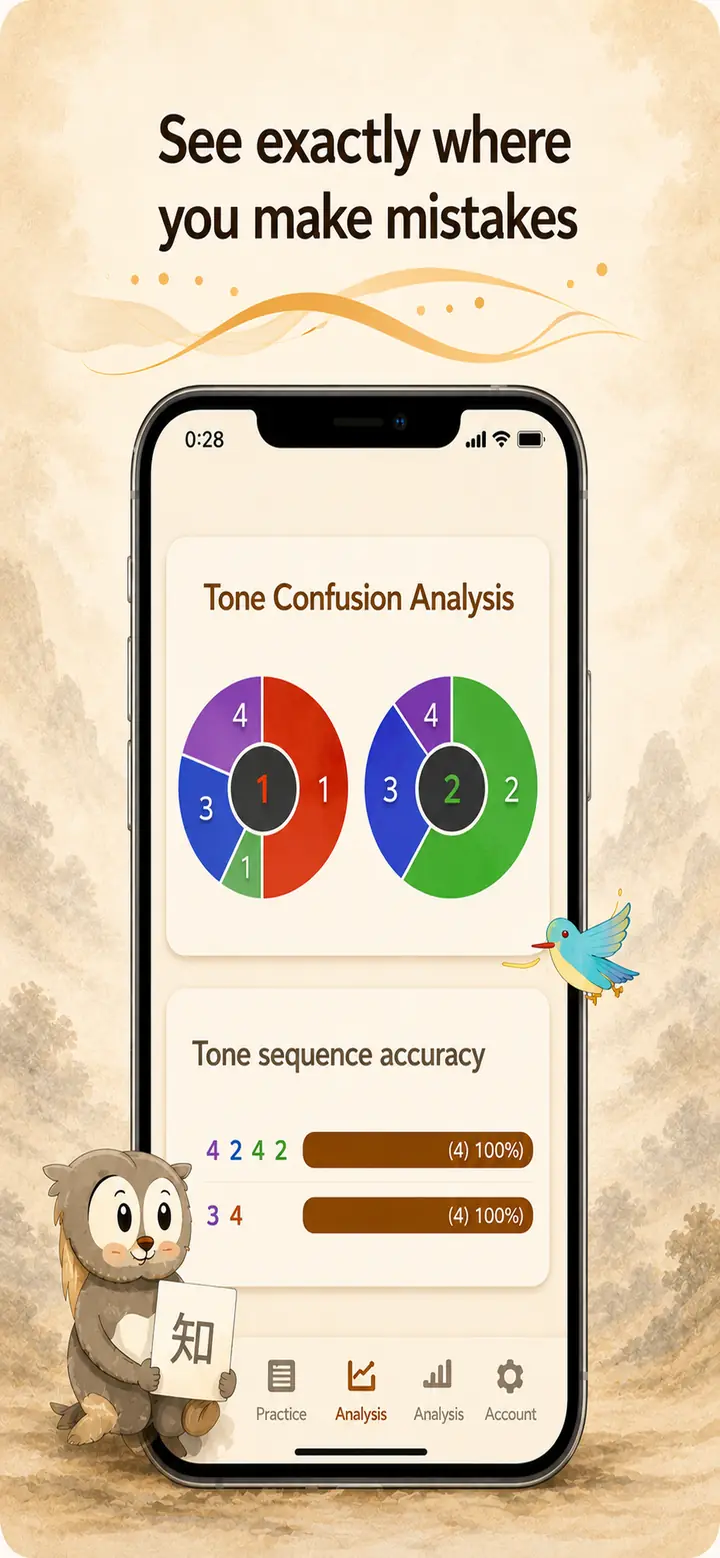
- Your Tone Confusion Analysis shows which tones blur for you; for most learners it confirms the 2 ↔ 3 confusion, then shows it shrinking week over week.
- When your recognition passes about 80%, switch the same deck to Speak mode and train production on the words you can now hear.