Chinese tones guide
Why Native Speakers Don't Understand You (It's Usually Tones)
It is the intermediate learner's classic wound: you build a perfectly grammatical sentence, deliver it — and get a polite, blank "嗯?" in return. At that level vocabulary and grammar are rarely the culprit. Tones usually are. And by now your tone errors are not random; they are systematic, invisible to you, and fossilized.
What fossilized errors are, and why yours are invisible
"Fossilized" is the term linguists use for an error that has stopped improving — a mistake that has been repeated so many times it has set like concrete and no longer responds to general practice. Every long-term learner has some. In tones, they usually take one of three shapes.
There is the single wrong word: a common word you learned with the wrong tone in your first year and have said wrong a few thousand times since, so confidently that it never occurs to you to check it. There is the whole-category shift: you systematically produce one tone when you mean another — tone 2 for tone 3 is the classic — across many words at once, so the error is not in any single word but in a habit that spans your vocabulary. And there is the positional error: sentence-final tones that flatten because English intonation reasserts itself at the ends of phrases, so your individual words are fine but your sentences drift.
What unites all three is that you cannot hear them. Your brain corrects your own speech on playback — it hears what you meant, not what you said — so your fossilized errors sound perfectly correct to the one person who most needs to notice them. This is not a lack of effort or ear; it is a structural blind spot, and it is precisely why these errors survive years of diligent study while everything around them improves. You cannot fix what you cannot perceive, so the whole game is making the errors visible.
Step 1: Get a diagnosis, not more practice
The instinct when natives stop understanding you is to practice more. It rarely helps, and it can hurt: undirected practice reinforces your errors along with everything else, pressing the concrete a little firmer. More reps of a fossilized mistake is just more fossilizing.
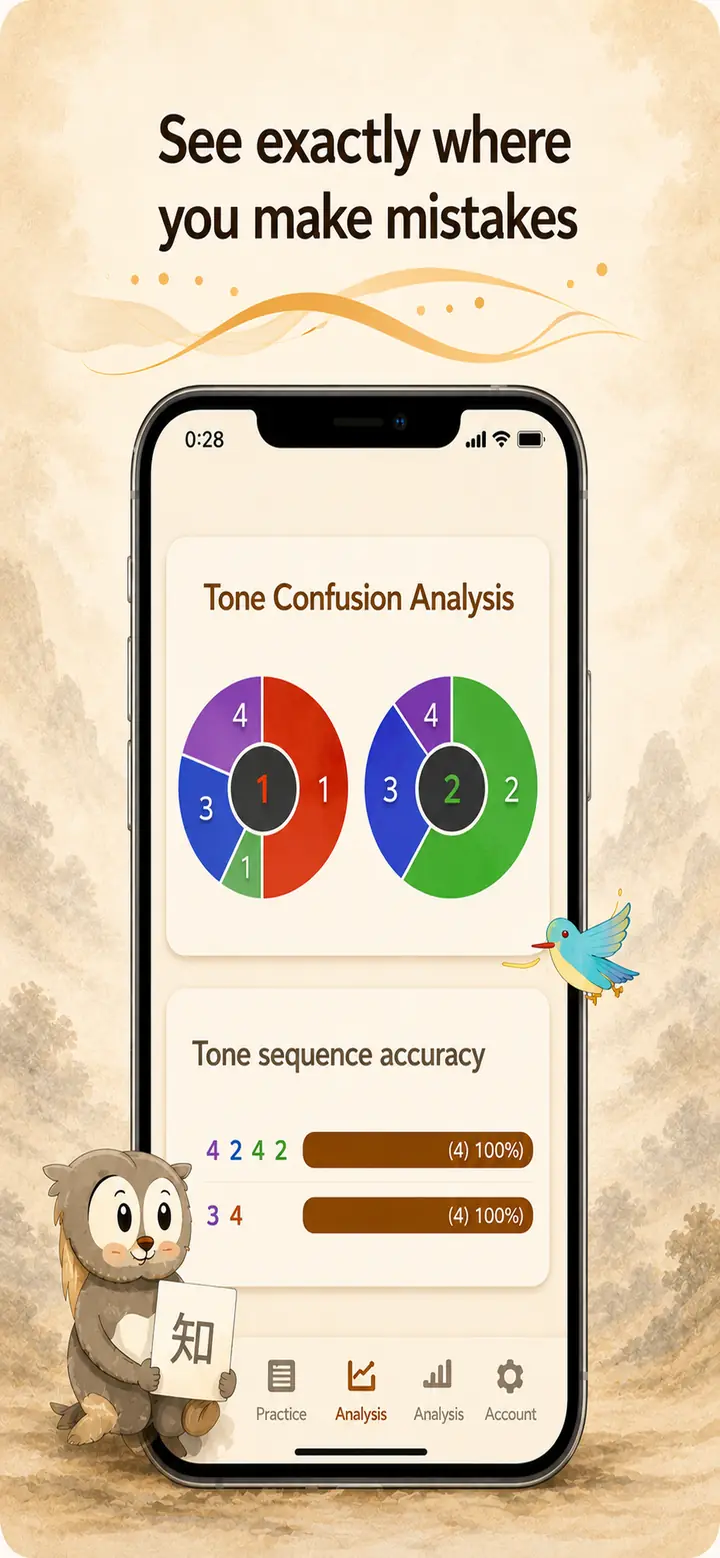
What you need first is not effort but information — a map. Specifically: which tones do you miss, on which words, and what do you produce instead? A patient teacher can build that map for you over many lessons, listening and noting patterns. Recorded practice with AI tone feedback builds it far faster, almost as a by-product, because every attempt is logged and sorted into a confusion matrix: "when the answer is tone 3, you produce tone 2 forty percent of the time." That single sentence is worth more than a month of unfocused drilling, because it turns a vague complaint — my tones are bad — into a specific, attackable target.
Step 2: Attack one confusion at a time
With the map in hand, resist the urge to fix everything. Pick the worst cell in the matrix — your most frequent, most costly confusion — and build a narrow deck that drills exactly that: the tone or tone pair you shift, inside words you actually use. A deck of nothing but tone-3 words and 3-3 pairs, or of your specific 2-for-3 offenders, concentrates all your reps on the one habit you are trying to break.
Because the target is narrow, progress is unusually fast. A confusion that has sat unchanged for years often moves dramatically after a week of ten-minute sessions aimed squarely at it — not because you suddenly practiced more, but because for the first time the practice was pointed at the actual problem instead of spread thinly across everything.
Step 3: Re-test the words you're sure about
Here is the counter-intuitive move: your oldest, most familiar vocabulary is where your worst errors hide. The words you learned first, you learned before your ear was any good, and you have said them confidently and unchecked ever since. Confidence is not accuracy — it is often just age.
So run your "easy" words back through recorded speaking practice, the everyday words you would never think to review. Most long-time learners are genuinely startled by which day-one words come back wrong: a number, a direction, a food, said thousands of times with a tone that has been quietly off the whole time. Re-testing what you are sure of is how you find the fossils you would otherwise never think to look for.
Step 4: Keep the streak, watch the trend
Fossilized habits yield to frequency, not intensity. They were built by thousands of small repetitions, and they come apart the same way — by many short, correct reps outnumbering the old wrong ones, day after day, until the new habit is the automatic one. A single heroic session does little; a daily ten-minute one does a great deal.
So make the practice small enough to sustain and let the numbers show you it is working. A per-tone accuracy line climbing month over month, a days-on-track streak you are unwilling to break, and a confusion map fading cell by cell — that is what getting un-stuck actually looks like, and seeing it on a chart is often what keeps a learner going through the unglamorous middle of the process.
Finding your error pattern in Atone
- Practice normally in Speak or Recall & Speak mode for a few days — every attempt quietly feeds your analytics.
- Open Analysis → Tone Confusion Analysis: the donut for each tone shows what you actually produce when that tone is the answer.
- Build a deck that targets your worst confusion and drill it; per-word accuracy shows which specific words are carrying the habit.
- Track per-tone accuracy month over month and keep your days-on-track streak alive — frequency is the cure, not intensity.