Chinese tones guide
Practice Tones on Your Own Vocabulary, Not Someone Else's Lessons
The fastest way to waste tone practice is to drill words you will never say. The words that earn your reps are the ones already in your life: this week's textbook chapter, your HSK list, and the word you fumbled in yesterday's conversation.
Why custom vocabulary changes everything
Two learners can put in the same ten minutes and get very different returns, and the difference is often just which words they drilled. Practicing your own vocabulary is not a nice-to-have; it changes what the practice is worth, for three reasons.
The first is transfer. Drill chōngdòng 冲动 (impulsive) tonight because it came up in your reading, and you can use it correctly tomorrow when the same topic returns. Practice on an app's stock word list transfers too — but only by luck, on the occasions its words happen to overlap with yours. Aiming your reps at words already headed for your mouth removes the luck.
The second is motivation, and it compounds quietly over months. Progress on words you actually need feels like progress in Chinese, because it is. Progress on an app's arbitrary list feels like progress in the app — a score going up in a game you did not choose to play. That difference in feeling is the difference between a habit that survives to week twelve and one that quietly lapses in week three.
The third is how tones are stored in the first place. Fluent speakers do not compute a word's tones from rules each time they say it; they remember the tones as part of the word, fused with its sound and meaning, the way you remember that "photograph" is stressed on the first syllable without deriving it. That means the memory you are trying to build is fundamentally per-word — so it should be built on your words, the specific ones you will retrieve in real sentences, not on a generic set you will never call up again.
Good sources for your decks
You are surrounded by better word lists than any app can guess. The trick is simply to notice them and funnel them into decks:
- Your textbook or course. One deck per chapter keeps your class and your tone practice in lockstep, so the words you are learning to read are the same ones you are learning to say. When Friday's lesson arrives, the vocabulary is already in your mouth, not just on the page.
- HSK vocabulary lists. Drill the tones of an HSK level before the listening section of the exam punishes you for guessing them. Tones you only ever met as pinyin marks fall apart under time pressure; tones you have spoken and had checked hold up.
- Conversation leftovers. Any word a native speaker had to repeat for you — or that you reached for and missed — goes straight into a deck. These are gold: the language itself just told you exactly which words your tones are failing on.
- Confusable sets. Words that differ only by tone — mǎi 买 (buy) versus mài 卖 (sell), wèn 问 (ask) versus wěn 吻 (kiss). Nothing builds respect for tones faster than a pair where the tone is the entire difference between two everyday words.
Per-word accuracy is the quiet superpower
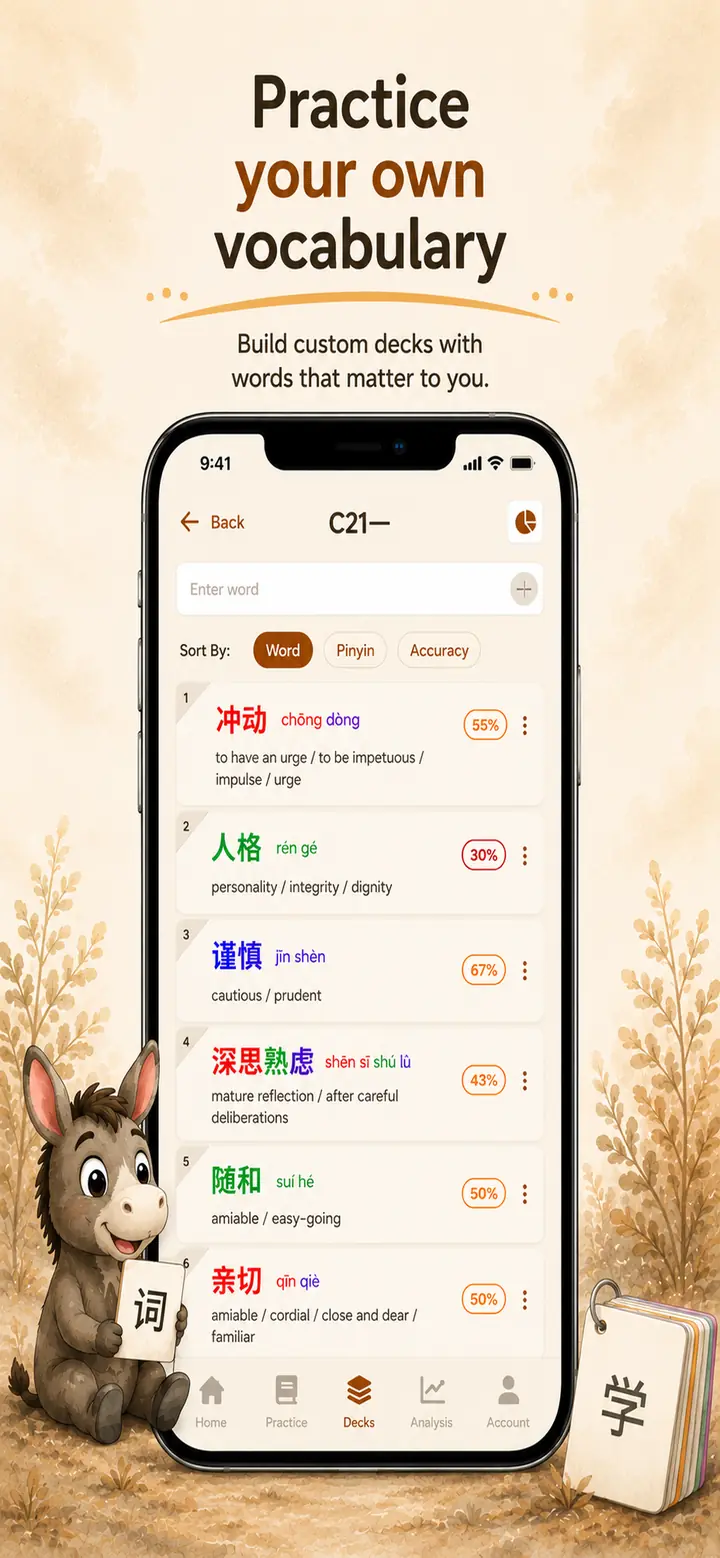
Once every word in a deck carries its own accuracy score, practice stops being a vague activity you do for a while and becomes triage you can act on. The workflow is almost embarrassingly simple: sort the deck by accuracy, drill the bottom of the list, and repeat tomorrow. The words you already own drop out of your attention on their own; the words still costing you rise to the top and get the reps.
That small change — knowing, per word, what is weak — is what separates aimless review from targeted practice. Ten focused minutes a day on your weakest twenty words moves you faster than an hour of evenly shuffled review, because in the shuffle most of your effort lands on words you already know. The score tells you where the effort will actually pay, so none of it is wasted on the easy ones.
Building your decks in Atone
- Create a deck and type any word — Atone's built-in dictionary (100,000+ entries) fills in the characters, pinyin and meaning for you.
- Already keep your words somewhere else? Atone Pro imports vocabulary lists from Pleco, Quizlet and other apps, so a list you have already built becomes a deck without retyping it.
- Practice the deck as any session type: Recall to name a character's tone, Speak to record it from pinyin, or Recall & Speak to read the character and say it.
- Every word shows its own accuracy, so you can sort the deck by score and drill the weakest words first instead of reviewing everything evenly.
- Filter the Analysis screen by deck to see how each chapter or list is coming along on its own.